
Artificial intelligence (AI) is no longer a future technology. It already reads medical scans, flags suspicious payments, recommends what we buy and writes first drafts of the content we read. Most articles about AI stop there, with a list of impressive use cases. This one asks a second question that rarely gets asked: does each of these applications include or exclude the 1.3 billion people who live with a disability?
The answer matters. The same systems that can open doors for disabled people can also lock them out faster and at greater scale than any badly built website. Below are seven industries where AI is making the biggest impact, what it is doing there, and what it means for accessibility.
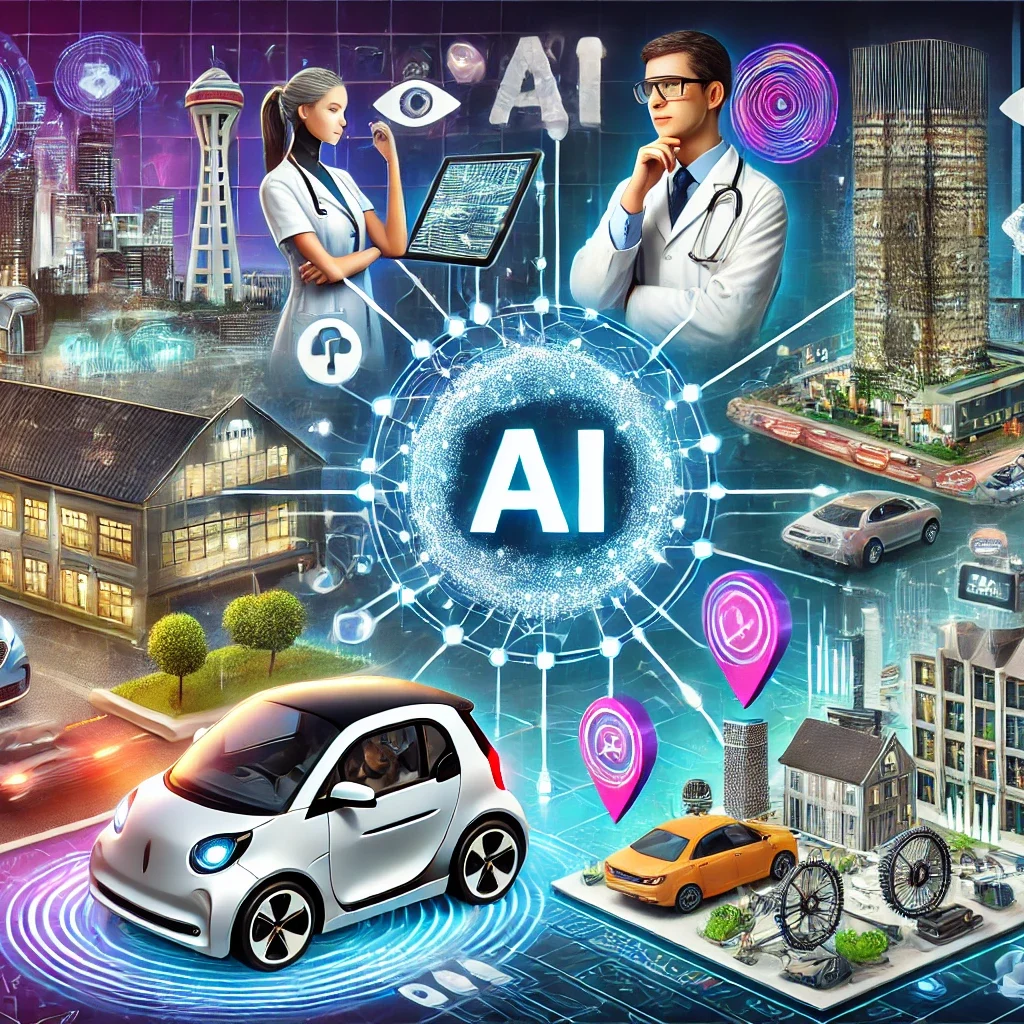
Key takeaways
- AI is reshaping healthcare, finance, retail, transport, education, manufacturing and content creation.
- In every one of these industries, AI can remove barriers for disabled people or create new ones.
- The difference usually comes down to whether disabled users were included in design, training data and testing.
- Accessibility standards such as WCAG still apply to AI-powered products. AI does not replace them.
1. Healthcare: faster diagnosis, more independent patients
AI models now help clinicians analyse medical imaging such as X-rays, CT scans and retinal photographs, highlighting areas that need a closer look. In research, AI-based protein structure prediction became so influential that its creators shared the 2024 Nobel Prize in Chemistry. Hospitals also use AI chatbots for appointment booking, triage questions and medication reminders.
The accessibility opportunity
For patients with disabilities, AI can make care more independent. Speech recognition lets people with limited hand movement update records or message their care team by voice. Automated transcription and captioning make telehealth consultations usable for Deaf and hard of hearing patients. Image description apps help blind people read prescription labels and appointment letters without waiting for help.
The accessibility risk
A patient portal with an AI chatbot is still a patient portal. If the chat window cannot be reached by keyboard, does not announce new messages to screen readers, or times out before a slow typist finishes, the “smart” front door becomes the barrier. Health data used to train diagnostic models can also under-represent disabled people, which can make predictions less reliable for them.
2. Finance: fraud detection, automated decisions and chatbots
Banks and payment companies use machine learning to spot unusual transactions in real time, often blocking fraud before the customer notices. AI also powers credit scoring, algorithmic trading and the chat assistants that now answer most routine banking questions.
The accessibility opportunity
Conversational banking can be easier than navigating a dense dashboard, especially for people with cognitive disabilities or low vision. Voice assistants can read balances aloud, and well-designed chat flows can break complex tasks such as disputing a charge into one plain-language step at a time.
The accessibility risk
Fraud systems that rely on “normal” behaviour patterns can flag disabled customers whose patterns differ. Examples include people who use assistive technology that changes typing rhythm, or carers who log in on someone’s behalf. Identity checks that depend on a selfie, a moving-face check or a visual CAPTCHA can lock out blind users entirely. Every automated decision needs an accessible way to reach a human.
3. Retail: personalised shopping and smarter inventory
Recommendation engines analyse browsing and purchase history to suggest products, which is the model that platforms like Amazon and Netflix made familiar. Behind the scenes, AI forecasts demand so stores stock the right products and waste less.
The accessibility opportunity
Visual search and AI-generated product descriptions can make online shopping far easier for blind and low-vision shoppers, if those descriptions are accurate and include the details that matter, such as colour, size, texture and fit. Personalisation can also reduce the number of pages someone has to navigate, which helps keyboard and switch users.
The accessibility risk
Recommendation carousels that auto-rotate, product filters that update without announcing results, and “AI shopping assistants” that open as unlabelled pop-ups are among the most common failures in e-commerce audits. Under the European Accessibility Act, which has applied to e-commerce in the EU since June 2025, these are legal risks as well as lost sales.
4. Transport: autonomous vehicles and smarter journeys
Self-driving technology from companies such as Tesla and Waymo combines cameras, radar, lidar and GPS with AI that interprets the road in real time. Waymo already runs driverless ride-hailing in several US cities. AI also optimises delivery routes, public transport timetables and traffic signals.
The accessibility opportunity
For many people who cannot drive, such as blind people, some people with epilepsy or people with significant mobility impairments, truly autonomous vehicles could be one of the biggest gains in independence in decades. AI journey planners that understand step-free routes, lift outages and real-time platform changes are already making public transport more usable.
The accessibility risk
That promise only holds if the whole journey is accessible: booking in an accessible app, finding the vehicle without relying on sight, getting in with a wheelchair or guide dog, and communicating with the vehicle when something goes wrong. A car that drives itself but can only be summoned through an inaccessible app does not solve the problem.
5. Education: personalised learning at scale
Platforms such as Khan Academy and Duolingo use AI to adapt lessons to each learner’s pace, strengths and mistakes. Teachers use AI tools to draft quizzes, mark routine assignments and spot students who are falling behind.
The accessibility opportunity
Adaptive learning can be transformative for students with learning disabilities such as dyslexia or ADHD, who often struggle with one-size-fits-all lessons. AI captioning makes recorded lectures accessible to Deaf students, text-to-speech supports struggling readers, and AI tutors can explain the same idea five different ways without losing patience.
The accessibility risk
AI proctoring tools that track eye movement or flag “unusual” behaviour during exams can wrongly penalise students who use screen readers, have tics, look away to process information or need extra time. Any learning platform must still meet WCAG, with keyboard access, captions, readable contrast and clear error messages, no matter how intelligent its recommendations are.
6. Manufacturing: predictive maintenance and collaborative robots
AI analyses sensor data from machines to predict failures before they happen, which reduces downtime and waste. On factory floors, collaborative robots (cobots) work alongside people, taking on repetitive or heavy tasks.
The accessibility opportunity
Cobots and AI-assisted tools can make physically demanding jobs possible for workers with mobility or strength limitations, and voice-controlled or simplified interfaces can open industrial roles to more people. Assistive exoskeletons, guided by AI, are being tested to reduce strain and injury.
The accessibility risk
Industrial software is often the least accessible software in an organisation, with dense control panels, colour-only status lights and audio-only alarms. If AI dashboards repeat those patterns, they exclude workers with colour vision deficiency, hearing loss or low vision. Alerts should always use more than one channel, such as sound, light and text together.
7. Content creation: AI-written text, images and alt text
Generative AI tools such as ChatGPT draft articles and emails, while image models such as DALL·E create illustrations from text prompts. The same technology now generates captions, summaries, translations and image descriptions automatically.
The accessibility opportunity
This is where AI has already changed daily life for many disabled people. Apps such as Be My Eyes and Microsoft’s Seeing AI describe photos, documents and surroundings for blind users. Automatic captions have made huge amounts of video content accessible, and plain-language rewriting tools help people with cognitive disabilities understand complex documents.
The accessibility risk
AI-generated alt text is often generic (“a person standing in a room”) or simply wrong, and AI captions still struggle with accents, technical terms and speakers with speech disabilities. Publishing them unchecked creates content that looks accessible on paper but misleads the people who rely on it. AI output should be a draft that a human reviews.
Where AI still fails disabled people
Across all seven industries, the same three problems come up again and again:
- Biased training data. If disabled people are missing from the data, the model learns that they are “unusual”. Speech recognition that has rarely heard dysarthric speech, or hiring tools trained on past hires, can quietly exclude them.
- Inaccessible interfaces around the AI. A brilliant model wrapped in a chat window that screen readers cannot use is still inaccessible. Most AI accessibility failures are ordinary WCAG failures.
- Over-promising automation. AI “fix-it” tools cannot make an inaccessible product accessible on their own. In April 2025 the US Federal Trade Commission ordered accessibility overlay provider accessiBe to pay $1 million over misleading claims that its AI tool could make any website compliant.
AI can remove barriers faster than any technology before it, but only if disabled people are part of the data, the design and the testing. Otherwise it automates exclusion.
A checklist for teams building AI-powered products
- Test every AI interface (chat windows, recommendation panels, voice flows) against WCAG 2.2 AA, including keyboard access and screen reader announcements.
- Include disabled people in user research and in model evaluation, not only in final testing.
- Check training data for under-representation of disabled users, older users and people who use assistive technology.
- Give every automated decision, such as a blocked payment, a rejected application or a failed identity check, an accessible route to a human.
- Treat AI-generated alt text, captions and summaries as drafts, and have a person review them before publishing.
- Never rely on a single sense: pair audio alerts with visual and text alternatives, and visual cues with text.
- Document accessibility in your AI governance alongside privacy, security and fairness.
Conclusion
AI is transforming healthcare, finance, retail, transport, education, manufacturing and content creation, and the pace is only increasing. For businesses, the opportunity is enormous. For disabled people, the stakes are even higher: the same technology can deliver more independence than ever before, or create barriers that are harder to see and harder to challenge.
The organisations that get this right will treat accessibility as part of how they build AI, not as a feature to add later. That means inclusive data, accessible interfaces and human oversight. As AI becomes part of every product, the future of web accessibility and the future of AI are becoming the same conversation.
Related reading
- The Promising Future of Web Accessibility: Trends, Challenges, and How Professionals Can Prepare for 2035
- Audio-First Design Heuristics for Accessible Interfaces
- What Is Digital Accessibility? A Practical Guide


Pingback: What Is Digital Accessibility? A Practical WCAG Guide
Pingback: How to Write Alt Text: Decision Guide and Examples (WCAG 1.1.1)